Caesar Rodney

BORN – October 7, 1728, at Byfied, the family farm on St. Jones Neck in East Dover Hundred, Kent County, DE. Parents (English ancestry) – Caesar Rodney, Sr. (b1707-d1745) and Elizabeth Mary Crawford Rodney (b1671-d1763). Eight Children – Caesar Rodney (b1728-d1784), Sarah Rodney (___, died young), Daniel Rodney (1741-d1764), William Rodney (b1738-d1787), Thomas Rodney (b1744-d1811), ___.
DIED – June 26, 1784 (age 55), at his home, Byfield Plantation, in Kent County, DE, from cancer. Religion – Anglican / Episcopalian. Buried - There are differing opinions on where Rodney is buried. Some believe that in 1888, Rodney’s remains were removed from the original gravesite at Byfield Plantation and reburied at Christ Episcopal Churchyard in Dover where a twelve foot granite monument was erected at his gravesite. Others maintain that his remains are still at the original burial site at Byfield Plantation, where the historical marker described below was installed.
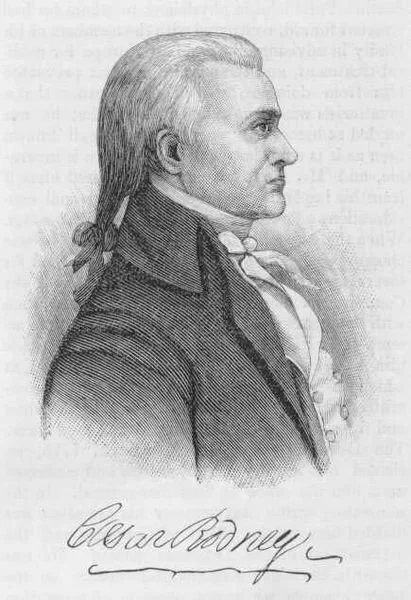
APPEARANCE – The picture above is a lithograph of Caesar Rodney from the "Signers of the Declaration of Independence," by Ole Erekson, published in 1876. No contemporary portrait exists, probably because his face was scared from cancer surgery. It plagued him for a decade prior to his death, which he had covered with a green silk veil. John Adams wrote in his diary – “Caesar Rodney is the oddest looking man in the world. He is tall, thin and slender as a reed, pale. His face is not bigger than a large apple, yet there is sense and fire, spirit, wit, and humor in his countenance.”
FAMILY – Did not marry and have children. The woman he loved, Mary (Polly) Vining, married another man and died soon after. Rodney was the eldest child. His father died when he was 17. For the rest of his life he assumed the role of father to the younger children in his family.
OCCUPATION – PLANTER, LAWYER, LEGISLATOR, JUDGE, SOLDIER. Home schooled. Inherited Byfield Plantation at age 17, when his father died. DE Militia Captain in the French and Indian War. Member of the Continental Congress representing Delaware from 1774 to 1776. General in the DE Militia. Governor of Delaware from 1778 to 1781.
AT SIGNING – Age 47 at signing. On the eve of the vote for independence Rodney was in Delaware. His fellow delegate, Thomas McKean was in favor of independence and George Read was against it. McKean sent Rodney a message that hw was needed in Congress for the vote. On the night of July 1-2, 1776, he rode all night on horseback, in the rain, on muddy roads, 80 miles to reach Philadelphia in time to vote for independence. The result was a 2 to 1 vote in favor of independence by Delaware. The ride has been compared to Paul Revere’s famous midnight ride in Massachusetts.
AFTER SIGNING - Recruited Delaware men to serve in the military. Served as a General in the Delaware Militia. Died less than a year after the end of the war.
HISTORIC SITES
Gravesite – Cemetery at Christ Episcopal Church Cemetery, Dover, DE (1734). Located at on Church Square at 523 S State Street, Dover, DE 19901, Phone (302) 734-5731, Website www.christchurchdover.org - or in an unmarked grave at nearby Byfield Plantation.
Dover Home - Byfield Plantation or Poplar Grove (1680’s). Located south of Dover on U.S. 113, just past the Dover Air Force Base. The roadside historical marker reads – “BYFIELD - Near this site stood the boyhood home of Caesar Rodney, signer of the Declaration of Independence. Byfield was originally settled in the early 1680’s by Daniel Jones, Rodney’s maternal great grandfather. Following Jones’ death, it became the family seat for three generations of the Rodney Family. Caesar Rodney spent his formative years here and eventually acquired ownership of the property after the death of his mother in 1763. Upon entering public life in 1764, Rodney moved to the town of Dover. Although the property was occupied by tenant farmers, Rodney retained Byfield until his death in 1784. He is buried in an unmarked family cemetery on the property.”
State House – Old State House, Dover, DE (1722). Located at 25 The Green, Dover, DE 19901
Phone 302-739-2438, Website www.history.delaware.gov/museums.
Statue – Caesar Rodney Equestrian Statue, Wilmington, DE (1922). Located in Rodney Square, in downtown Wilmington, DE. Statue of Rodney on a galloping horse commemorating his famous ride from Dover to Philadelphia, PA.
State Quarter – Rodney’s famous ride from Dover to Philadelphia, PA is depicted on the backside State quarter coin which was minted in 1999 commemorating the State of Delaware. The coin was the first to be issued in the State quarter series, because Delaware was the first of the new States to ratify the U.S. Constitution on December 7, 1787.
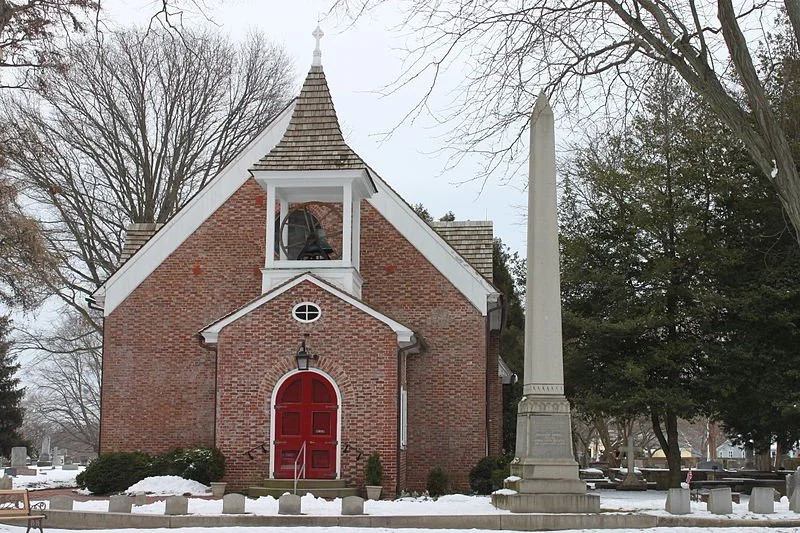
Gravesite of Caesar Rodney, Christ Episcopal Church, Dover, DE (1734).
Located at on Church Square at 523 S State Street, Dover, DE 19901, Phone (302) 734-5731, Website www.christchurchdover.org.
When Dover was formally laid out by William Penn’s surveyors in 1717, two religious squares were designated. Meeting House Square, now the state of Delaware State Museum, was reserved for “Dissenters” (Presbyterians) and Church Square, east of Water Street, was reserved for the Church of England (Anglicans / Episcopalians). The original Church Square was southwest of the present square, and was relocated to its present site in 1734. The central portion of the present Christ Church building was begun on the new square the same year. Caesar Rodney was a member of the church. He is buried in the church cemetery or at his nearby Byfield Plantation.