John Hancock

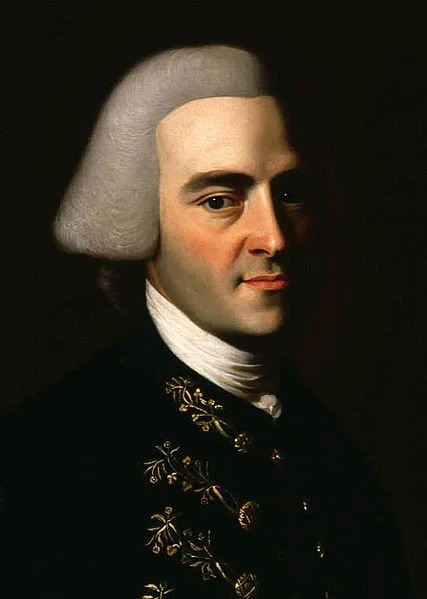
BORN – January 23, 1737, in Braintree (now Quincy), MA. Parents (English ancestry) – John Hancock, Jr. (b1702-d1744) and Mary Hawke Thaxter Hancock (b1711-d1783). He was Mary’s second husband and she would marry a third time after his death. She had a half-brother and sister to John with her third husband, a boy and a girl which were stillborn. Children – Mary Hancock Perkins (b1735-d1779), John Hancock (b1737-d1793), Ebenezer Hancock (b1741-d1819), Lucy Hancock (b1744-___).
DIED - October 8, 1793 (age 56) at his home, Hancock Manor, in Boston, MA. Religion – Congregationalist (Puritan), Member of the Brattle Street Congregationalist Church, Boston, MA. Buried - Old Granary Burying Ground, Boston, MA.
APPEARANCE – The picture above is the portrait of John Hancock (age 33 to 35) painted by John Singleton Copley in 1770 to 1772.
FAMILY – Married - Dorothy (Dolly) Quincy (b1747-d1830) in 1775. Two Children – Lydia Henchman Hancock (b1776-d1777, as infant), John George Washington Hancock (b1778-d1787, age 8).
OCCUPATION – BUSINESSMAN, LEGISLATOR. Graduated from Harvard College (now Harvard University) in 1754 (Classic Studies). Managed and inherited a profitable mercantile business (House of Hancock) from his uncle (Thomas Hancock) along with 22,000 acres in MA, CT, ME, making him one the wealthiest men in the Colonies. Member of the Continental Congress representing Massachusetts from 1774 to 1780. President of the Second Continental Congress in 1775. General in MA Militia. Governor of MA from 1780 until his death in 1793.
AT SIGNING – Age 39 at signing. Was president of Congress when the Declaration of Independence was adopted and signed. Primarily remembered by Americans for his large, flamboyant signature on the Declaration, so much so that "John Hancock" became, in the United States, an informal synonym for signature. According to legend, Hancock signed his name largely and clearly so that King George could read it without his spectacles. Spent heavily on the war from his personal fortune.
AFTER SIGNING – Continued to serve as the President of Congress in Philadelphia until 1780. Spent heavily on the war from his personal fortune.
HISTORIC SITES
Lexington Home - Hancock-Clarke House Museum, Lexington, MA (1738). Located at 35 Hancock Street, Lexington, MA 02420, Phone 781-861-0928, Website www.lexingtonhistory.org. John Hancock lived here from 1744 to 1750, with his grandfather, after his father died.
Gravesite - Old Granary Burying Ground, Boston, MA (1660). Located at 100 Tremont Street, Boston, MA 02111, next to the Park Street Church and near the site of the Boston Massacre, Phone 617-635-4505, Website cityofboston.gov.
Brother’s Home - Ebenezer Hancock House, Boston, MA (1767). Located at 10 Marshall Street, Boston, MA 02108. Home of John Hancock’s younger brother. Only dwelling still standing in the city of Boston that can be associated with John Hancock.
NY Home – John Hancock Replica House Museum, Ticonderoga, NY (1925). An exact replica of the Hancock, Manor, originally located on Beacon Hill, Boston, MA where the state capitol building now stands.
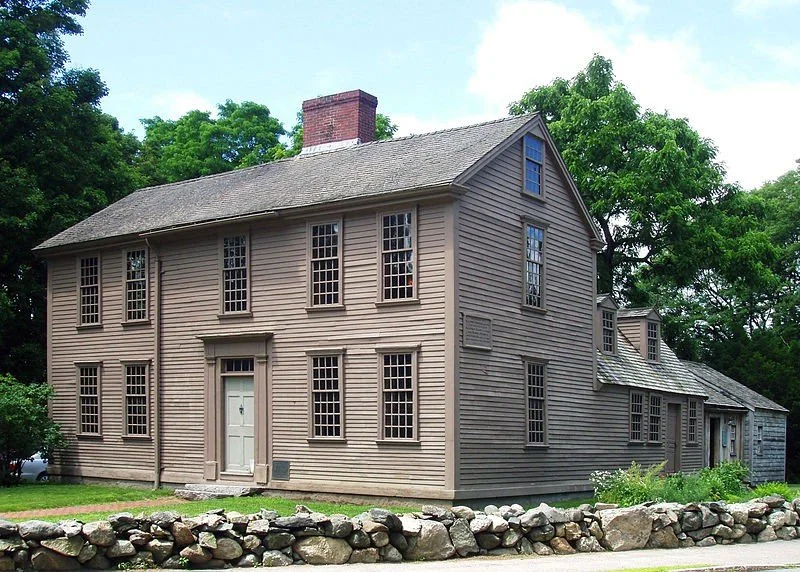
Hancock-Clarke House Museum, Lexington, MA (1738).
Located at 36 Hancock Street, Lexington, MA 02420, Phone 781-861-0928, Website www.lexingtonhistory.org.
This house is the only surviving residence associated with John Hancock. He lived here from 1744 to 1750, with his grandfather, after his father died. The house played a prominent role in the Battle of Lexington and Concord as both John Hancock and Samuel Adams, leaders of the colonials, were staying in the house before the battle. Arriving separately, Paul Revere and William Dawes stopped to warn Hancock and Adams around midnight of the advancing British troops, then set off for Concord.