William Hooper

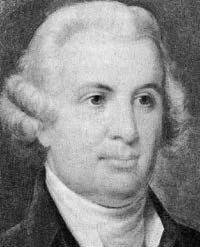
BORN – June 17, 1742, in Boston, MA. Parents (Scottish and English ancestry) – William Hooper (b1704-d1767) and Mary Dennie Hooper (b1717-d1779). Six Children – William Thomas Hooper (b1742-d1790), John Hooper (b1744-d1813), George Hooper, (b1744-d1821), Mary Hooper Spence (b1748-___), Thomas Hooper (b1751-d1821), Absalom Hooper, Sr. (b1753-d1845).
DIED – October 14, 1790 (age 48), in Hillsborough, NC. Religion – Anglican / Episcopalian. Buried – Originally buried in Hillsboro Old Town Cemetery, Hillsboro, NC. His remains were reburied at Guilford Courthouse National Military Park, Greensboro, NC in 1848, along with the remains of fellow Signer, John Penn.
APPEARANCE - The picture above is the portrait of William Hooper (age ___) painted by James Reid Lambdin in 1873, based on the image in the earlier painting by John Trumbull titled “Declaration of Independence”.
FAMILY – Married - Anne Clark (b1767-d1795) in 1767. Six Children (three surviving to adulthood) – William Hooper (b1768-d1804), Elizabeth (Betsy) Hooper Watters (b1770-d1840), Thomas Hooper HH(b1772-d1828), Arenas Hooper (b1774, died infant), Son (b1776, died as infant), Daughter (b1778, died as infant).
OCCUPATION - LAWYER, PHYSICIAN, LEGISLATOR, JUDGE. Graduated from Harvard College (now Harvard University) in 1760, and then studied law. Moved to Wilmington, NC in 1764 (because there were too many lawyers in Boston) and established his law practice. Member of the Continental Congress representing North Carolina from 1774 to 1777. Joined his family in Hillsborough in 1780. Federal Judge from 1789 to his death in 1790.
AT SIGNING – Age 34 at signing. First to sign the Declaration of the three member delegation from New Carolina. Was known as the “Prophet of Independence”, having made the earliest known prediction of independence in a 1774 letter to his friend James Iredell - “The Colonies are striding fast to independence, and ere long will build an empire upon the ruins of Great Britain; will adopt its Constitution, purged of its impurities, and from an experience of its defects, will guard against those evils which have wasted its vigor.” John Adams in his diary (1774-1804), states that Patrick Henry, Richard Henry Lee, and William Hooper were the "Orators of Congress."
AFTER SIGNING – Continued to serve in Congress in Philadelphia until 1777. Throughout the Revolutionary War the British attempted to capture Hooper. With his country home at Finian on Masonboro Sound, south of Wilmington being vulnerable to British attacks, he moved his family to Wilmington. The British shelled and destroyed his house at Finian and burned the house in Wilmington. His arm was badly injured. Fled from home, living house to house in the Windsor-Edenton area and a year later followed his family to Hillsborough.
HISTORIC SITES
Hillsborough Home - Nash-Hooper House, Hillsborough, NC (1772). Located at 118 West Tryon Street, Hillsborough, NC 27278. Privately owned. William Hooper lived in the house from 1782 until his death in 1790. The roadside historical marker reads – “WILLIAM HOOPER – 1742-1790 – One of North Carolina’s three signers of the Declaration of Independence. His home is 150 yrds W (yards West). Was buried a few yards W (yards West).” William Hooper’s homes at Finian and Wilmington, NC no longer exist.
Gravesite - Guilford Courthouse National Military Park, Greensboro, N.C. Located at 2332 New Garden Rd Greensboro, NC 27410, Phone 336-288-1776, Website www.nps.gov/guco. Remains are buried underneath the Signers Monument.
Battlefield – Battle of Alamance (Creek), Burlington, NC (1771). Located at 5803 NC Route 62 South, six miles south of Burlington, N.C. 27215, Phone 336-227-4785, Website www.nchistoricsites.org/Alamance. Fought on May 16, 1771, between the Governor Tryon’s British NC Militia and the Colonial Regulators, the battle was a precursor to thee Revolutionary War. William Hooper accompanied the British Militia at the battle resulting in the defeat of the Regulators.
Governor’s Palace – Tryon Palace and Gardens, New Bern, NC (1770). Located at 610 Pollock St, New Bern, NC 28562, Phone 800-767-1560, Website www.tryonpalace.org. William Tryon was the British Governor of the Colony of North Carolina from 1765 to 1771. The main building was destroyed by fire in 1798, and reconstruction was completed in 1959. William Hooper accompanied Governor Tryon’s troops to the Battle of Alamance.
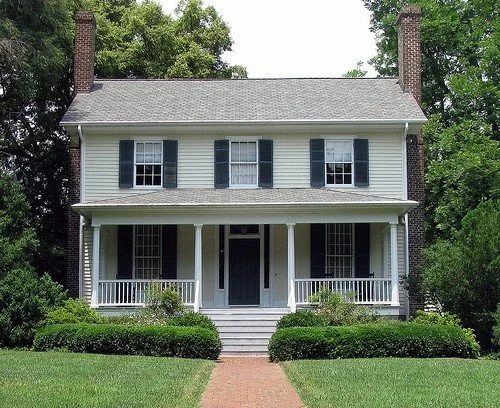
Nash-Hooper House, Hillsborough, NC. (1772).
Located at 118 West Tryon Street, Hillsborough, NC 27278. Privately owned.
The house was built by Francis Nash. He became a Revolutionary War hero and was killed as a General in the Battle of Germantown in 1777. The house was purchased by William Hooper in 1782, who lived in the house until his death in 1790. His earlier homes at Finian and Wilmington were destroyed by the British and no longer exist.
Hooper was buried to the east of his home in the garden. That part of the garden was later added to the town cemetery, behind the Presbyterian Church. In 1894, Hooper's remains were reburied at Guilford Courthouse National Military Park, N.C., though his original gravestone and some of his remains are believed to reside in the Hillsborough cemetery. The new gravesite has a nineteen foot statue of William Hooper dressed in colonial garb in an orator's pose which still stands.