Thomas Jefferson

BORN – April 13, 1743 at Shadwell, VA. Parents (English ancestry) – Peter Jefferson (b1708-d1757), and Jane Randolph Jefferson (b1720-d1776). Ten Children (eight surviving to adulthood) – Jane Jefferson (b1740-d1765), Mary Jefferson Bolling (b1741-d1817) Thomas Jefferson (b1743-d1826) inherited 1900 estate in 1764, Elizabeth Jefferson (b1744-d1774), Martha Jefferson Carr (b1747-d1811), Peter Field Jefferson (b1748-d1748, as infant), Son (b1750-d1750, as infant), Lucy Jefferson Lewis (b1752-d1784), Anna Scott Jefferson Marks (b1755-d1805), Randolph Jefferson (b1755-d1815, age 10).
DIED – July 4, 1826 (age 83) at his home, Monticello, Charlottesville, VA. He was deeply in debt. Thomas Jefferson and fellow signer John Adams were political adversaries, but became good friends and corresponded regularly in their later years. Both died on the same day – July 4 (exactly 50 years after the approval of the Declaration). On his deathbed at his home in Quincy, MA, Adams’ last words were – “Thomas Jefferson still survives.” He was mistaken. Jefferson had died five hours earlier at Monticello. Religion – Anglican / Episcopalian (Deist). Buried – family cemetery at Monticello.
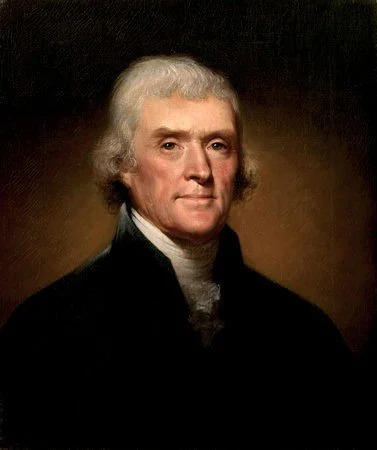
APPEARANCE – The picture above is the portrait of Thomas Jefferson (age 57) painted by Rembrandt Peale in 1800, at the White House during Jefferson’s Presidency. Tall (6 foot, 2 inches), slender, freckled, sandy hair, prominent cheek bones and chin, straight as a gun barrel, large hands, dignified.
FAMILY – Married - Martha Wayles Skelton (b1748–d1782) in 1772. Six Children (two surviving to adulthood) – Martha (Patsy) Jefferson Randolph (b1772-d1836), Jane Randolph (b1774-d1775, as infant), Peter (b1777-d1777, as infant), Mary (Polly) Jefferson Eppes (b1778-d1804), Lucy Elizabeth (b1780-d1781, as infant), Elizabeth (b1782-d1784, as infant). Based on DNA and other evidence, the consensus of most modern historians, Jefferson is believed to have fathered one or more of the children of one of his slave, Sally Hemings, after the death of his wife, Martha.
OCCUPATION – PLANTER, LAWYER, LEGISLATOR, VA GOVERNOR, DIPLOMAT, U.S. VICE PRESIDENT, 3rd U.S. PRESIDENT. Graduated from the College of William & Mary in 1762. Member of the Continental Congress representing Virginia from 1775 to 1776. Governor of VA from 1779 to 1781. U.S. Minister to France from 1784 to 1789. U.S. Secretary of State from 1790 to 1793. 3rd U.S. President from 1801 to 1809. Accomplishments during his presidency were the Louisiana Purchase, establishment of the U.S. Military Academy at West Point. Led the founding of the University of Virginia in Charlottesville. Collected a large library of 6,000 books which he sold to become the foundation of the books of the Library of Congress.
AT SIGNING – Age 36 at signing. Member of the Committee of Five that drafted the Declaration - John Adams, Roger Sherman, Robert Livingston, Benjamin Franklin, Thomas Jefferson. Jefferson was assigned to draft the document. The first draft took him 17 days to prepare following the resolution by Richard Henry Lee on June 7, 1776. The Committee of Five, selected to draft the Declaration consisted of Thomas Jefferson, John Adams, Benjamin Franklin, Robert Livingston, Roger Sherman.
AFTER SIGNING – While serving as the Governor of VA in 1781, he was forced to flee the Capital in Richmond from the British Army and then from Monticello to Poplar Forest near Lynchburg, VA.
HISTORIC SITES
Monticello – Monticello Plantation, Charlottesville, VA (1768). Located at 931 Thomas Jefferson Parkway, Charlottesville, VA 22902, Phone 434-984-9800, Website www.monticello.org.
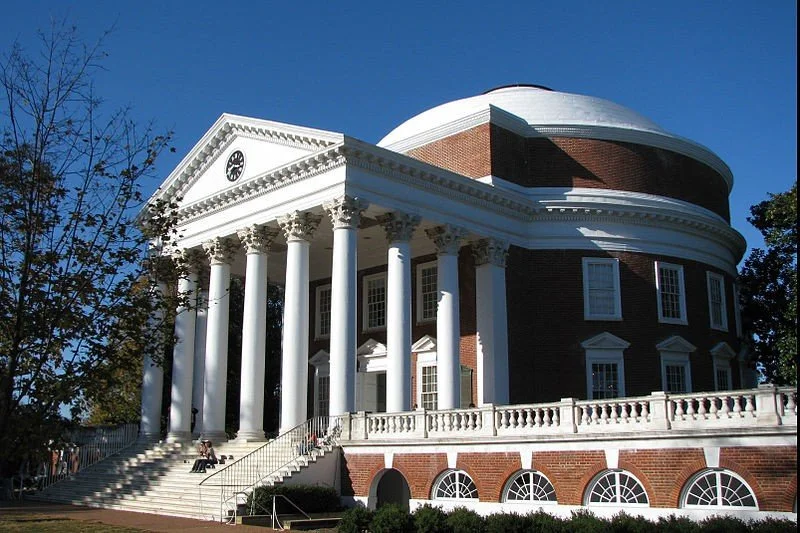
University – Rotunda, University of Virginia, Charlottesville, VA (1826). Located at 1827 University Avenue, Charlottesville, VA 22904, Phone 434-924-0311, Website www.virginia.edu. Founding led by Jefferson.
Poplar Forest – Poplar Forest Plantation, Lynchburg, VA (1806). Located at 1542 Bateman Bridge Road, Forest, VA 24551, Phone 434-525-1806, Website www.poplarforest.org. Jefferson’s summer home inherited through his wife Martha.
Tuckahoe – Tuckahoe Plantation, Richmond, VA (1733). Located at 12601 River Road Richmond, VA 23238, Phone 804-784-5736, Website www.tuckahoeplantation.com. Childhood home of Jefferson.
Palace – Governor’s Palace, Williamsburg, VA (1710 - Reconstructed). Located at the south end of the Palace Green, Williamsburg, VA 23185, Phone 800-447-8679, Website www.colonialwilliamsburg.com. Jefferson’s home when he was serving as the Governor of the new State of Virginia from 1779 until the VA Capital was moved to Richmond in 1780.
Capital – Virginia State Capital Building, Richmond, VA (1785). Located at 1000 Bank St Richmond, VA 23219, Phone 804-698-1788, Website www.virginiacapitol.gov. Design led by Jefferson.
Natural Bridge – Natural Bridge of Virginia. Located at 15 Appledore Lane, Natural Bridge, VA 24578, Phone 800-533-1410, Website www.naturalbridgeva.com. Jefferson purchased 157 acres including the Natural Bridge in 1774 which he owned until his death in 1826.
Memorial – Jefferson Memorial. Washington, D.C (1943). Located at 900 Ohio Drive SW, Washington, DC 20242, Phone 202-426-6841, Website www.nps.gov/thje.
Sculpture – Mount Rushmore National Memorial, Keystone, SD (1941). Located at 13000 South Dakota 244, Keystone, SD 57751, Phone 605-574-2523, Website www.nps.gov/moru.
Rotunda, University of Virginia (UVA), Charlottesville, VA (1826).
Located at 1827 University Avenue, Charlottesville, VA 22904, Phone 434.924.0311, Website www.virginia.edu.
The Rotunda is a building located on The Lawn on the original grounds of the University of Virginia. It was designed by Thomas Jefferson to represent the "authority of nature and power of reason" and was inspired by the Pantheon in Rome. Construction was begun in 1822 and was completed in 1826, after his death. The grounds of the new university were unique in that they surrounded a library housed in the Rotunda rather than a church, as was common at other universities in the English-speaking world.
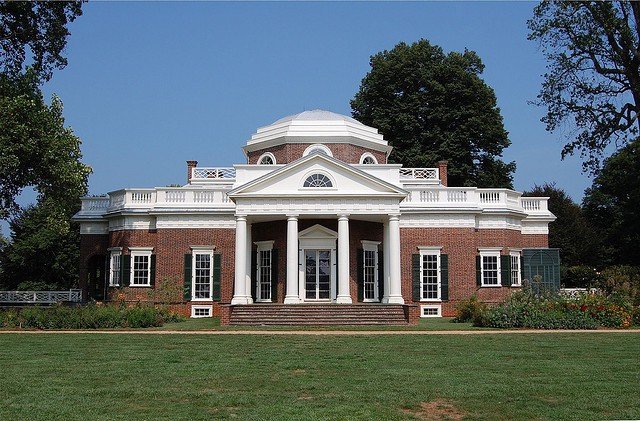
Home of Thomas Jefferson, Monticello Plantation, Charlottesville, VA (1768).
Located at 931 Thomas Jefferson Parkway, Charlottesville, VA 22902, Phone 434-984-9800, Website www.monticello.org.
Monticello was the home of Thomas Jefferson. Work began on what historians would subsequently refer to as "the first Monticello" in 1768, on a plantation of 5,000 acres. Monticello means Hillock or Little Mountain in Italian. The house was remodeled and expanded over a fifteen year period from 1794 to 1809. Jefferson and his wife Martha, are buried at Monticello. The inscription on his grave stone reads – “Here was buried Thomas Jefferson, Author of the Declaration of American Independence, of the Statute of Virginia for religious freedom Father of the University of Virginia”.